
I just finished Cloud Cuckoo Land by Anthony Doerr1. In it, there are at least 5 different times across at least 7 narrators, but every single one is written in present tense. Recently, I’ve noticed a lot more books than usual in present tense, so I wondered if this was just a coincidence, or if there really has been a rise.
It turns out that I’m not the only one who has noticed this. But so far as I can tell, no one has actually attempted to quantify it. Has it really increased? By how much? There’s no real data. This post attempts to get it, and answer my questions.
Numbers aside, people seem to have strong thoughts about this trend. Liza Libes wrote an interesting piece in early 2025 which claims:
In writing a novel in the present tense, authors of literary fiction strive to emphasize the “now,” reflecting an obsession with the immediate self at the expense of perspective and reflection.
Here’s ornery British author Philip Pullman (of His Dark Materials), in 2010:
This wretched fad has been spreading more and more widely. I can’t see the appeal at all… When a language has a range of tenses such as the perfect, the imperfect, the pluperfect, each of which makes other kinds of statement possible, why on earth not use them?
I have bad news for the grumpy Brit: Since 2010, it’s only gotten worse.
The Data
I fetched NYT Fiction Bestsellers by year from 1931 to 2025, then got excerpts from the books via Goodreads Quotes. Then I had GPT 5.6 Terra or Claude Sonnet 52 classify each excerpt and roll that up into a label for what tense the “base narration” of the book was in.
Without further ado:
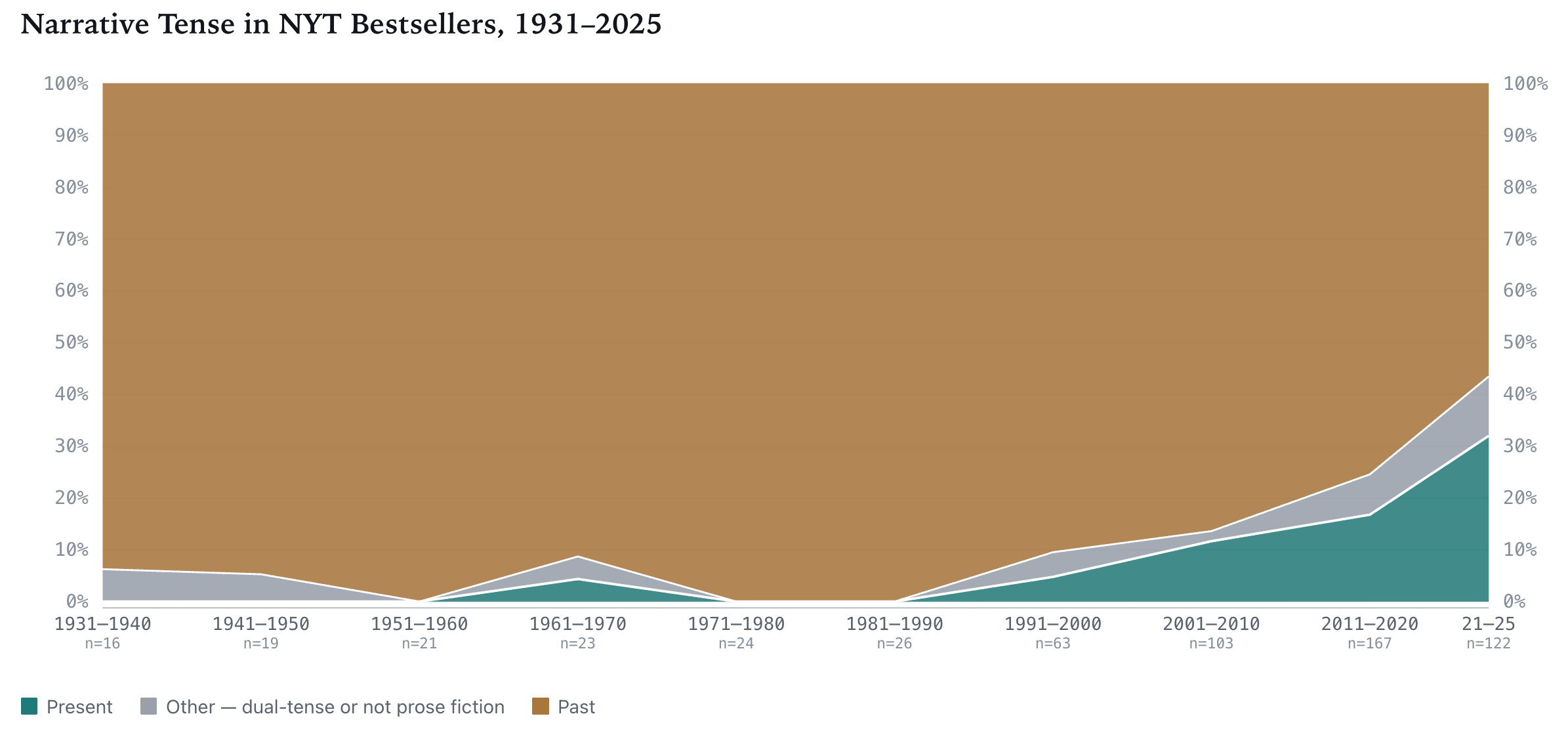

What a result! Essentially no usage whatsoever until 2000, then a rapid rise from there to a third of top fiction bestsellers in 2020-2025. The last 25 years have averaged a 1.1% increase in present tense prevalence per year.
Zooming in on just the last 3 decades:
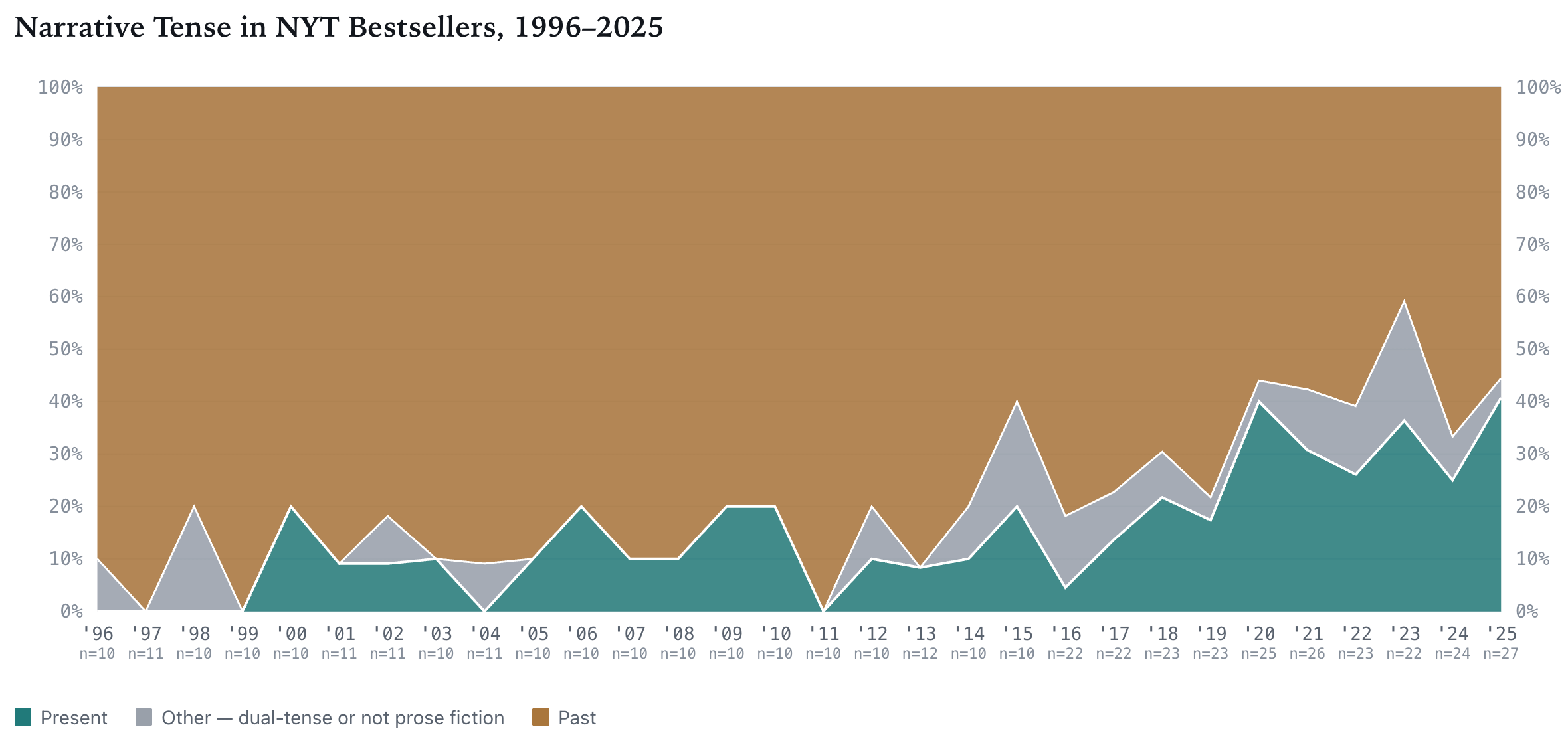
2025 has 41% of books in present tense! The last five years average around 32%, and even 2006-2015 sees ~13% of books in present tense, which is a huge jump from the ~0% of prior decades.
The 10-year buckets from the prior chart obviously hide a fair bit of noise, and the sample sizes here are small enough that any given year should be taken with a grain of salt. But there’s still an undeniable upwards trend, especially since 2000 and again in ~2012. Dual tense books — alternating between tenses, usually also jumping time periods at the same time, also have become more popular. The Notebook by Nicholas Sparks (1996) does this, alternating Noah’s present-day present tense with his in-story past tense narration of his own life.
The Past and Present of Present Tense
Pre-1950:
Extremely sparse use. There are a few tepid forays, but it’s so infrequent that the zeitgeist seems to not even have bothered to form an opinion.
Charles Dickens’ Bleak House comes up as one of the first major Western novels to try it out, in 1852. My dataset just misses them, but Faulkner’s As I Lay Dying (1930) and James Joyce’s Ulysses (1934) also contain significant present tense (although are mostly past tense). Apparently, they are among the first books to use present tense for internal monologue, not just narration.
Only 2 books in the dataset have the “dual” label and use significant present tense. The earliest is Invitation to the Waltz (1932), which has diary entries that alternate with past tense narration.
1950-2000:
Slightly more popular, although still quite rare, there are the first stirrings of opinions. Present tense narration seems to have been regarded as something between avant-garde and a gimmick.
The first present tense book that makes it into the dataset is 1968’s Myra Breckenridge by Gore Vidal. It’s an intentionally provocative, diary-style novel about which Time asked “Has literary decency fallen so low?”. It contains, per the NYT, “the ambidextrous orgy-scene; the sadistic daydreams of the protagonist; her diddlings of the male anatomy, en route to the sphincter”.
Many resources cite Atwood’s The Handmaid’s Tale (1986) as a seminal work in present tense. It doesn’t quite make the dataset, ranking 25th in the 1986 NYT Bestseller list. Sparknotes (lol) says this is to ensure “we too are stuck in the present moment of her story”. Present tense was probably a choice given a fair bit of thought - Atwood first became prominent as a poet.
Prior to around 2000, present tense seems to have been viewed as a rebellious choice, even sometimes a gimmick. Roland Barthes, a French literary theorist, wrote in 1977:
The preterite, which is the cornerstone of Narration, always signifies the presence of Art… It presupposes a world which is constructed, elaborated, self-sufficient, reduced to significant lines, and not one which has been sent sprawling before us, for us to take or leave.
I found this quote as part of a 2010 New Yorker article that wonders if present tense, Twitter and iPhones are all connected as phenomena causing “our world flattening into a series of equally important (or unimportant) actions that pass us by without commentary”. Jonathan Haidt, welcome to the past tense resistance.
Which of course, brings us to the present era.
2000-Present:
Since the dawn of the new millennium, something in the authorial waters has clearly shifted. Present tense has moved from a novelty to a regular feature of literature. In the last 5 years specifically, present tense has climbed to more than a third of bestsellers.
The next fully present tense book after 1968’s Myra Breckenridge in the dataset is fully 27 years later, the year 1995 exactly, moving us into the “present era” (haha) with the start of a new tense fad. It is The Rainmaker by John Grisham, a much more mainstream author and tale.
The Hunger Games (2008) is widely credited with launching the tense’s popularity in Young Adult Fiction. Unfortunately, it doesn’t make this dataset, since it’s listed in NYT’s Youth Fiction section. Books like Iron Flame and Onyx Storm by Rebecca Yarros (2023 and 2025, both present tense) do make the dataset, bleeding in from that side of literature.
Looking at books with present tense, to me it seems associated with very non-gimmicky books. Anthony Doerr’s All The Light We Cannot See (2014) won a Pulitzer, Sara Gruen’s Water for Elephants (2006) got a broadway musical, Andy Weir’s Project Hail Mary (2021) got a blockbuster movie. Stephen King has even joined the fun - 6 his latest novels make it into the dataset in the last 5 years, and half are written in the present tense — despite most of his historical works being past tense.
2010 is also when the quote from the intro about the “wretched fad” from Philip Pullman comes up. Apparently 3 of 6 shortlist novels for the Booker Prize in 2010 were written in present tense. Philip Henscher, commenting on the same drama, compared the trend to “Japanese knotweed”.
Liza Libes has a similar thought in her article:
Is this the purpose of great literature? Of course not—our ADHD-ridden society has simply convinced publishers that readers prefer books that turn pages to books that explore a unique facet of the human condition. The shift towards the present tense exemplifies this unfortunate trend away from critical thought, creating a battalion of books that stand with “the now” rather than with the “stop and think.”

I’m not sure I’m convinced? Certainly I feel Anthony Doerr manages to write beautifully reflective, human pieces while using present tense. Cloud Cuckoo Land is nothing if not an exploration of literature through various deeply human stories. Personally, I don’t feel tense is as totalizing a choice as its critics make it sound.
Critics focus on present tense pulling you into “now now now”, creating urgency and immediacy. It may do that, but I also feel it pulls you closer to the characters, situating you more directly in their fictional experiences. In the past tense, an author asks you to reflect on life of a stranger. In the present tense, you are instead asked to live it. Perhaps that’s less reflective. But experience is sometimes the more visceral teacher.
Methodology
My website has an interactive version of all this data, including book-by-book labels, 1st/3rd person labels, and more. Check it out here.
The utterly disorganized GitHub repo that has all of the raw data is here.
I want to be totally clear: Some of the book labels in the dataset are almost certainly wrong. Since I don’t have access to the actual textual content of all these books, I was forced to rely on Goodreads Quotes. Contextless pull-quotes are an inherently suspicious source of information for classifying a book’s narrative tense. Nonetheless, here’s how I went about it:
Pull top N Hardcover Fiction bestsellers for each year, by time on list. For 1931–2020, I used the Post45 Data Collective’s cleaned historical dataset of weekly NYT bestseller appearances. For 2021–2025, I fetched weekly lists from the NYT Books API.
Find the Goodreads book ID for that book. This was via automated crawl with automatic verification of title/author/year for the resulting book.
Pull the Goodreads Quotes for that book. For example, Cloud Cuckoo Land has 326 quotes. Deduplicate.
Label each quote as Event, Dialogue, Gnomic, or Paratext, or Unclear. This takes some explaining.
Event is the core of what we’re looking for. “Bob walked to the store”. Great evidence the book is past tense.
Dialogue can trip things up. “Bob walked to the store” is great evidence for past tense, but only if not followed by “, Mary says”. Only used when there is a “narrative beat” like “he says” that can function as an event quote.
Gnomic also trips things up. This is narrative asides like “Stores are filled with goods you can buy”. Often present tense, but has nothing to do with what tense the narration is in. These are dropped.
Paratext is things like the dedication, front cover, etc. Drop.

Roll these labels up to a book-level classification. I instructed the LLM to do its best to ignore things like prologues, interior monologues, narrative asides, etc, and focus on attempting to identify the “base” story narrative tense.
Some books had to be dropped for lack of quotes or lack of clarity given the quotes available. These are listed in the dataset as “Abstain”. Overall, the dataset contains 584 labelled books from 21,377 quotes.
Which I recommend, by the way! It was good, once I was able to keep track of the like 7+ narrators/timelines. Great ending.
This project made heavy use of AI (but this post is entirely human). Classifying a book’s narrative tense is not as simple as old-school NLP phrase tense classifiers (see methodology section). I think LLMs are well suited to tease out the nuance, but still, labels won’t be perfect.
Also, I burned a lot of tokens. Sponsor me, OpenAI/Anthropic? I could run this on Youth Fiction and other Bestseller sections, and generate enough labels to give some interesting breakdowns. You can brag about pushing boundaries in literary analysis as well as conjectures.