
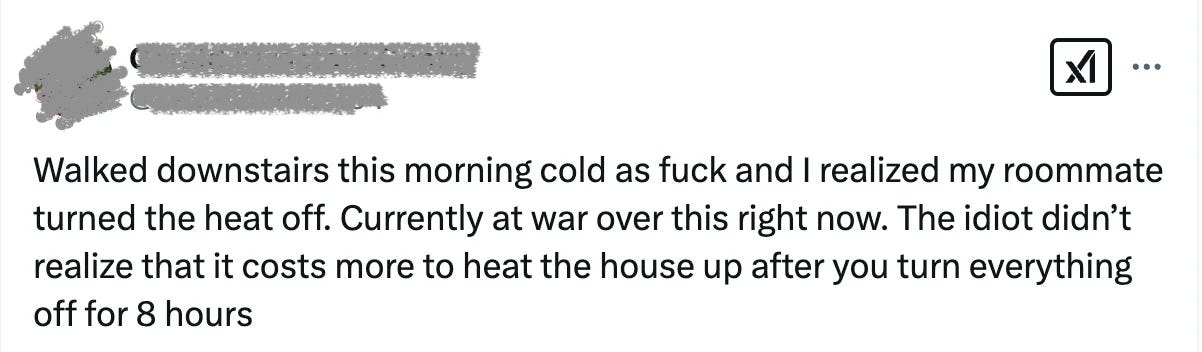
133,000 people (as of writing this post) liked this tweet saying that this guy’s roommate is an idiot because he “didn’t realize that it costs more to heat the house up after you turn everything off for 8 hours”.
Is this claim correct? No.
But is there nuuuuaaance that could be missing? Also (probably) no!
The core claim is just wrong, and all the “nuance” I’ve seen so far does not save it.
Why It’s Wrong
The equation for heat loss is very simple:

k is the conductivity of the material - basically the inverse of how well insulated your house is. ∇T is the difference in temperature between inside and outside the house. q is how much heat you’re losing.
Since for a given house, k is fixed, how much heat you lose is solely a matter of how much hotter your house is than the outside air. The warmer your house, the more heat you’re losing. This is true whether you’re keeping the heater on all night to maintain a set temp, or letting your house cool through the night.
The confusion seems to be that intuitively, people feel like it “takes a lot of energy” to heat your house back up to a comfortable temperature. But the energy you’re putting into heating your house back up is the energy that was lost in the night! If you kept the heater on through the night, it would require that same amount of energy to maintain the temperature, plus more because maintaining the higher temperature all night means more heat escapes.
Think of it like a bucket with a hole in the bottom. The more you fill the bucket, the higher the water pressure, so the faster it leaks out the bottom. You can constantly be keeping the bucket full with your hose, and always be replacing the water gushing out the bottom. Or, you can let it mostly empty so the water coming out is a trickle, then fill it back up again when you want to. Any water you spend filling it back up is water you would have had to put in to keep it full anyway.
If the intuition doesn’t convince you, we can run through a quick example. Let’s say it costs $1 for every degree of heat in your house, which you and your roommate keep at 72 degrees. Must be a big house. Being the considerate roommate you are, you turn the heat off before you go to bed. Throughout the night, the house drops 20 degrees, waking you up to a chilly 52 degrees.
In the morning, presumably while your roommate posts mean things about you on twitter, you’ll pay $20 to get the house back up to temp.
If we plug these values into Newton’s Law of Cooling:

This would imply a k of 0.0742.
The next night, your roommate goes to bed after you and makes sure the heater is on, keeping the house at 72 degrees all night. Using our original heat loss equation (from the top), that gives us an equivalent of 31.16 degrees lost, or $31.16 spent to keep your house warm all night! Time to go write a smug blog post on Substack to refute your roommate’s mean tweets.
If you’re interested in empirical evidence, this guy tried both approaches on his hot tub, and there’s a fun demo here where you can play around with different variables.
But NUANCE!
I have seen a lot of confident attempts to complicate this basic model, none of which are very convincing. The recurring theme is either being outright wrong, or inflating a small effect. Let’s go through some of them.
“Turning your heater off and on is expensive!”
This one seems to argue there is a large fixed cost to activating and deactivating the heater repeatedly which outweighs the benefits, which I am skeptical of outright.
But most heaters work by turning off and on to maintain a certain temperature anyway! The time it takes your house to cool to your new maintenance temperature is actually a period when there won’t be an on/off cycle, so if anything the “let it get cold” approach is better here. I’ve seen heat pumps mentioned here as an exception, but they shouldn’t be - heat pumps with variable speed are still uncommon.
Regardless, if we give in and find real estimates for the starting cost, we get comically low values that are nowhere near what would be needed to be relevant. It’s hard to find an estimate, but for motors I found that the unit will draw 5x its normal operating power for… .1 seconds. That’s 0.000243 kWh for a random heat pump unit I found. Enjoy your savings.
“But heat pumps and temperature differential!”
I see this everywhere, but heat pumps get more efficient the less the difference in temperature between the source and destination. This means they’re more efficient, not less, when you’ve let your house cool towards the outdoor temperature. Another point for the idiot roommate.
“But condensation!”
I’ve seen 3 reasons to worry about condensation, which will increase as the temp lowers.
One of them is very good, but has nothing to do with heating efficiency: mold. Yea. Bad. You should worry about this.
The second is that the “phase change” makes it hard to heat back up again. This is nonsense - the phase change takes energy in both directions. Condensation in the night will slow the cooling of your house, and the evaporative cooling in the morning will slow it heating back up.
The third is the condensation accumulating on walls and insulation, harming the insulation of your house. This site estimates that 20% in moisture could up to halve the effectiveness of your insulation. I assume that’s 20% by weight? If so, air holds around 0.00192 lb of water per cubic foot at room temp. I found the density of some batting insulation and ran a back of the envelope calculation assuming 10x more volume in air than insulation, and arrived at a ratio of roughly 1:500 in weight of insulation vs. condensation. That means as long as it dries out in the morning, a single night is negligible. But the buildup could be a problem (see also: “mold”).
“But time of use pricing!”
Maybe your electric/gas company has time of use billing, so it’s more expensive to heat your house in the morning. Fair, but you could still turn it off for most of the night and heat it back up before the price increase period starts.
“But fast heating is inefficient!”
Electric heaters are 100% efficient regardless of draw - they turn all the energy you put into them into heat. Even vibration from a running motor turns into heat from friction and other dissipation. Thanks, conservation of energy.
It’s true that some heat pumps have variable speeds that are less efficient at higher speeds, and apparently the same is true of some gas boilers. Some heat pumps also have backup resistive coils that will activate in a pinch to speed heating. Does this matter in practice?
Seems like plausibly yes, for the coils at least. The COP of heat pumps is 2-4ish, and the coils are 1, so in our toy example $20 vs. $31 would turn into $20 vs. ($31 / 3 -> ~$10.3).
If you’re worried about this, I recommend setting your thermostat to heat your house up slowly starting a couple hours before you wake up. Almost every thermostat that can maintain a fixed temperature can also set a schedule.
“But…”
There’s an infinite list of potential objections. Some of them are probably even correct, in some cases. This post is written in an argumentative tone, but I’ll admit it’s at least conceivable that, whether from condensation buildup, resistive coil fallbacks, or really inefficient “fast draw” of certain models, it’s possible that heating your house up from cool is less efficient than keeping the heater on all night.
But based on what I’ve seen, a lot of people seem to have a much more basic misconception that it takes way more energy to heat a house back up than keep it at a fixed temperature all night. That’s not correct, and the difference is large enough that most objections are small in comparison.
Closing Thoughts
When you look around, you see this advice everywhere. There’s this StackExchange post from a guy whose energy company recommended it, this abc article that makes a claim about heat pump running efficiency that probably doesn’t pan out in real life, and a truly shocking number of hot tub companies making the same faulty claim about leaving their hot tubs on all the time.
If you’re worried about mold, or frozen pipes, or just being cold, keep the heat on, at least a little. But if you’re only interested in lowering your heating bill, turn it off.